
For decades, IEEE 754 floating-point arithmetic has been the bedrock of scientific computing. However, as we push the boundaries of Deep Learning, climate modeling, and edge computing, the limitations of traditional floats, such as wasted bit patterns, overflow issues, and the complexity of handling subnormal numbers, have become apparent.
Posit arithmetic offers a hardware-friendly alternative that provides tapered precision: it allocates more bits to the fraction for values near 1.0 (where most computation occurs) and more bits to the exponent for very large or small values.
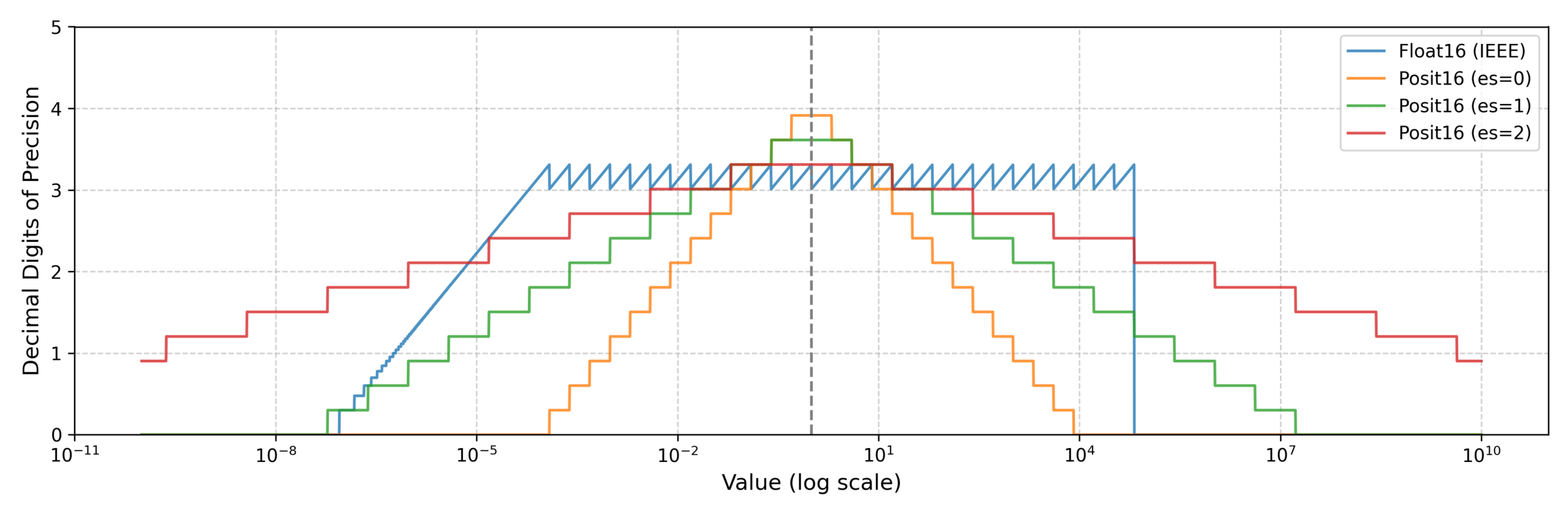
While the theoretical advantages of posits are clear, their adoption depends on robust hardware implementation. My research bridges the gap between mathematical theory and physical realization:
- Custom Hardware Accelerators: Development of high-performance, area-efficient hardware accelerators specifically optimized for posit arithmetic. These cores are designed for compute-intensive tasks where power-to-precision ratios are critical, such as neural network inference and signal processing.
- RISC-V ISA Extensions: To enable general-purpose computing with posits, a custom RISC-V extension is developed. This allows developers to utilize posit arithmetic within a standard software toolchain, integrating posit functional units directly into the processor pipeline alongside traditional integer and floating-point units.